

TCM basics
Five elements and five organs
Wood, fire, earth, metal and water map to liver, heart, spleen, lung and kidney.
TCM uses the five elements to describe how organ systems relate: wood (liver), fire (heart), earth (spleen), metal (lung) and water (kidney). They nourish and also restrain each other.
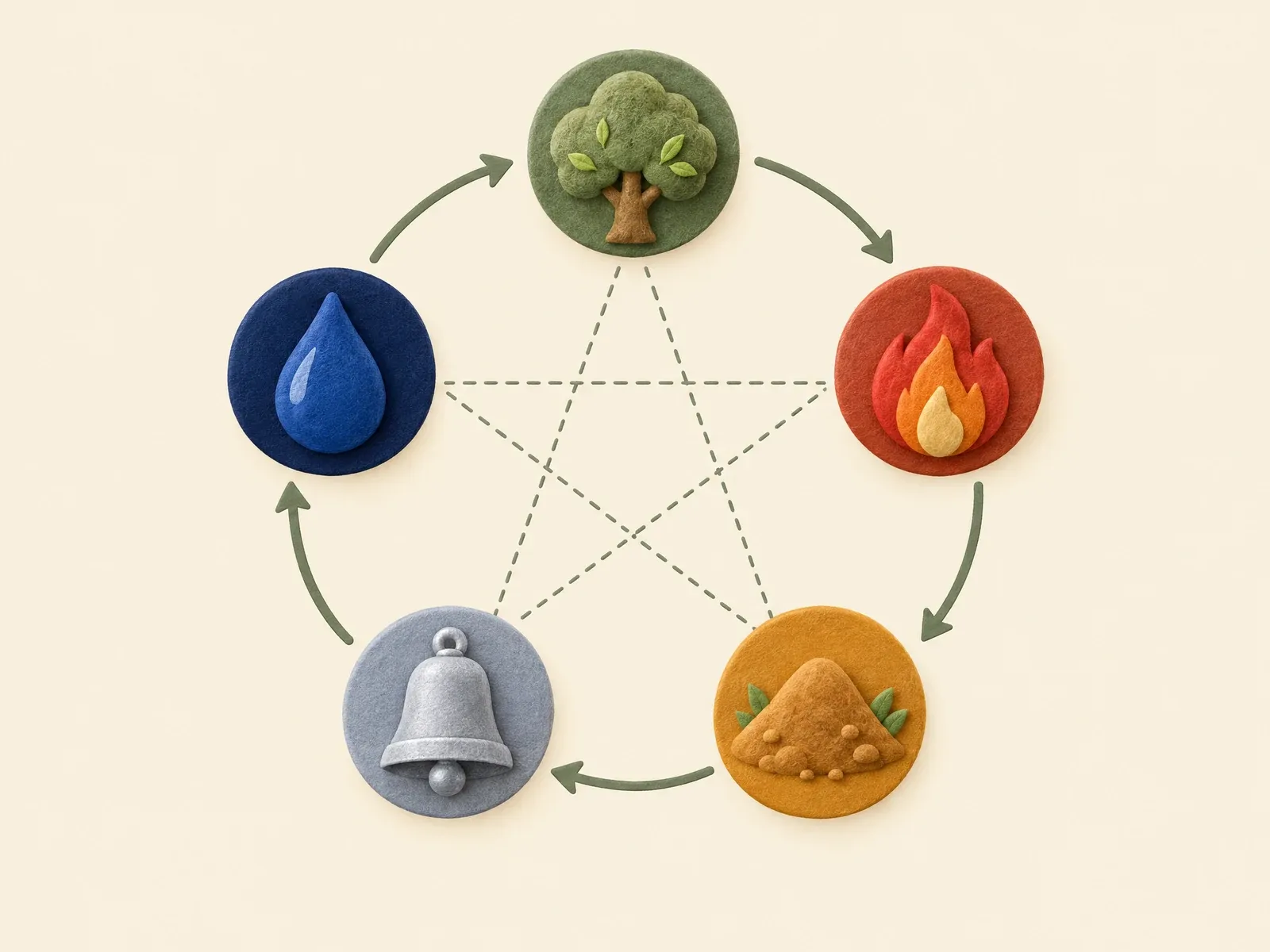
Nourishing: like a family looking after each other
The nourishing cycle runs wood, fire, earth, metal, water and back to wood. The easiest way to remember it is to picture nature: wood burns to make fire, fire leaves ash that becomes earth, earth holds metal ores, water beads on cool metal, and water feeds the trees.
In the body, TCM reads it like this. The liver (wood) keeps qi and blood moving, which supports the heart (fire). The heart's warmth supports digestion in the spleen and stomach (earth). Good digestion nourishes the lungs (metal). The lungs govern breathing and, together with the kidneys (water), help manage the body's fluids. Each link looks after the next.
Each element also has a matching point traditionally used for everyday care: wood (liver) is Taichong (LR3) on top of the foot, fire (heart) is Shenmen (HT7) on the wrist, earth (spleen) is Zusanli (ST36) below the knee, metal (lung) is Lieque (LU7) on the forearm near the wrist, and water (kidney) is Taixi (KI3) beside the inner ankle. Ask a practitioner before pressing Taichong in pregnancy.
Restraining: checks and balances, not harm
The restraining cycle runs wood over earth, earth over water, water over fire, fire over metal and metal over wood. "Restrain" sounds harsh, but it means keeping each other in check, like water and heat when you cook rice: too little water and it burns, too much heat and it boils over.
An everyday example: many people lose their appetite or get an upset stomach when they are stressed or angry. TCM describes this as "liver wood overacting on spleen earth", meaning that emotional stress affects digestion. Seeing that link helps explain why looking after your stomach sometimes starts with relaxing, not only with what you eat.
Link to the seasons
Spring (wood) focuses on the liver, summer (fire) the heart, late summer (earth) the spleen, autumn (metal) the lungs and winter (water) the kidneys, which is why seasonal eating shifts focus.
In Hong Kong you might use it like this. Around the damp spring days, keep an eye on mood and sleep and eat a little lighter. In the summer heat, focus on drinking enough and resting. In the humid weeks between summer and autumn, go easy on greasy food and look after digestion. In dry autumn, choose moistening foods. As winter cools, sleep earlier and eat a little warmer. These are directions, not rules; always match the real weather and how you feel.
Five colours: putting the five elements on your plate
TCM also matches five colours to the five organs: green with the liver, red with the heart, yellow with the spleen, white with the lungs and black with the kidneys. Think green spinach, red adzuki beans, yellow pumpkin, white Chinese yam and black beans.
A simple habit is to get several colours on the table each day: pumpkin and millet congee for breakfast, a plate of stir-fried spinach at lunch, Chinese yam soup at dinner, and red bean or black soy milk as a sweet treat. More colours naturally means more variety, which points the same way as modern advice on a balanced diet.
Spinach is high in oxalate, so if you have had kidney stones, blanch it first and watch portions. Beans can cause wind; cook them soft and keep portions moderate if your digestion is sensitive. For more on each one, see the Related acupoints and Related ingredients sections below.
A common misunderstanding: the five elements are five organs?
The liver, heart, spleen, lungs and kidneys in TCM are not exactly the anatomical organs. They are groups of functions. The TCM "spleen", for example, mainly means digestion and absorption, which is different from the spleen in Western medicine. So "spleen deficiency" does not mean something is wrong with your spleen, and "liver fire" does not mean abnormal liver blood tests.
The five elements are not fortune-telling either. They are a map that ancient thinkers used to understand how nature and the body relate. Use it as a way of understanding; if you have real symptoms, see a healthcare professional.
Remember
The five elements are a relationship map — the reason TCM looks at the body as a whole.
Related ingredients
Based on traditional Chinese medicine for general wellness education — not a medical diagnosis or treatment. If symptoms persist, are severe or unusual, please see a doctor or registered Chinese medicine practitioner.